
Characters/Gemynd: Difference between revisions
Auto-sync: PF2e character exporter. |
Auto-sync: PF2e character exporter. |
||
| Line 18: | Line 18: | ||
| languages = ysoki | | languages = ysoki | ||
| wealth = 1 PP, 13 GP, 12 SP, 8 CP | | wealth = 1 PP, 13 GP, 12 SP, 8 CP | ||
| last_kill = Common Eurypterid (2026-07-07) | |||
| last_downed = Air Scamp (2026-07-06) | | last_downed = Air Scamp (2026-07-06) | ||
}} | }} | ||
| Line 113: | Line 114: | ||
! Coin !! Total Value !! Bulk !! Invested | ! Coin !! Total Value !! Bulk !! Invested | ||
|- | |- | ||
| 1 PP, 13 GP, 12 SP, 8 CP || 37.33 gp || | | 1 PP, 13 GP, 12 SP, 8 CP || 37.33 gp || 6.7 / 5 enc / 10 max || 0/10 | ||
|} | |} | ||
</div> | </div> | ||
| Line 605: | Line 606: | ||
</div> | </div> | ||
''Last synced: 2026-07- | ''Last synced: 2026-07-11 00:40'' | ||
[[Category:Characters]] | [[Category:Characters]] | ||
Revision as of 05:40, 11 July 2026
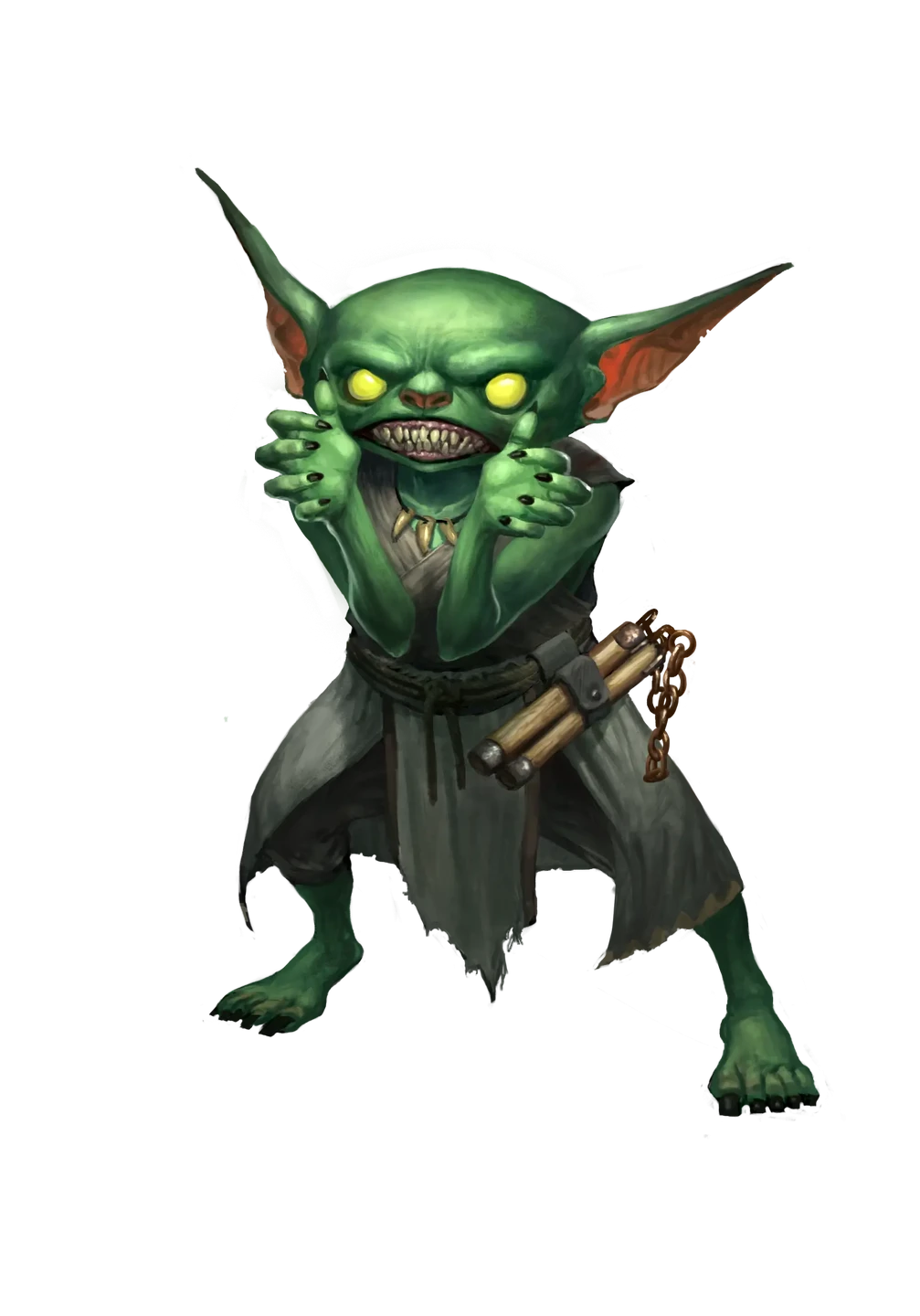
Gemynd
| Gemynd | |
|---|---|
 |
|
| Level | 2 |
| Size | Medium |
| Key Ability | STR |
| Hero Points | 1 |
| Defenses & Combat | |
| HP | 22/22 |
| AC | 16 |
| Saving Throws | Fort +6, Ref +6, Will +6 |
| Perception | +4 |
| Speed | 25 ft. |
| Combat Record | |
| Last Kill | Common Eurypterid (2026-07-07) |
| Last Downed By | Air Scamp (2026-07-06) |
| Attributes | |
| STR +0 | |
| Languages | ysoki |
Details
- Ancestry:
 Goblin
 - Heritage:
 Dokkaebi Goblin
 - Background: Scout
- Class: Psychic
- Key Ability: STR
- XP: 157
- Hero Points: 1
- Languages: ysoki
Identity
- Height: 3 ft 2 in
- Weight: 37 lbs
Campaign Notes
Boon of Earth +1 to any save
⚔ Defense & Saves
- HP: 22/22
- AC: 16
- Perception: +4 (Trained)
- Speed: 25 ft. (land)
- Fortitude: +6 (Trained)
- Reflex: +6 (Trained)
- Will: +6 (Expert)
- Active Conditions: Grabbed
📊 Ability Scores
| STR | DEX | CON | INT | WIS | CHA |
|---|---|---|---|---|---|
| +0 | +2 | +2 | +1 | +0 | +2 |
🎓 Skills
| Skill | Modifier | Proficiency |
|---|---|---|
| Acrobatics | +2 | Untrained |
| Arcana | +1 | Untrained |
| Athletics | +4 | Trained |
| Crafting | +5 | Trained |
| Deception | +6 | Trained |
| Diplomacy | +2 | Untrained |
| Forest | +5 | Trained |
| Intimidation | +2 | Untrained |
| Medicine | +0 | Untrained |
| Nature | +0 | Untrained |
| Occultism | +5 | Trained |
| Performance | +2 | Untrained |
| Religion | +0 | Untrained |
| Society | +1 | Untrained |
| Stealth | +6 | Trained |
| Survival | +4 | Trained |
| Thievery | +6 | Trained |
💰 Wealth & Carry
| Coin | Total Value | Bulk | Invested |
|---|---|---|---|
| 1 PP, 13 GP, 12 SP, 8 CP | 37.33 gp | 6.7 / 5 enc / 10 max | 0/10 |
✨ Feats & Features
Heritage
- Dokkaebi Goblin (goblin)
- Your ancestors mastered illusion-based magic, giving you an innate understanding of it. You can cast Figment as an innate occult cantrip at will. A cantrip is heightened to a spell rank equal to half your level rounded up. You also gain a +1 circumstance bonus to Will saves against illusions.
Background Features
- Scout
- You called the wilderness home as you found trails and guided travelers. Your wanderlust could have called you to the adventuring life, or perhaps you served as a scout for soldiers and found you liked battle.
Choose two attribute boosts. One must be to Dexterity or Wisdom, and one is a free attribute boost.
You're trained in the Survival skill and a Lore skill related to one terrain you scouted in (such as Forest Lore or Cavern Lore). You gain the Forager skill feat.
Feats
 Alchemical Crafting (general, skill)
- You can use the Craft activity to create alchemical items. When you select this feat, you immediately add the formulas for four common 1st-level alchemical items to your formula book.
- Cantrip Expansion (bard, cleric, magus, oracle, psychic, sorcerer, witch, wizard)
- Bard, Oracle, Sorcerer Study broadens your range of simple spells.
Cleric You study a wider range of simple spells.
Magus, Wizard Dedicated study allows you to prepare a wider range of simple spells for every situation.
Psychic You expand what your mind can accomplish.
Witch Your patron recognizes your need for flexibility and versatility, and grants you the power to prepare a wider range of simple spells.
Prepared You can prepare two additional cantrips each day.
Spontaneous Add two additional cantrips from your spell list to your repertoire.
 Conscious Mind (psychic)
- Whatever the subconscious source of a psychic's power, all find that a specific external manifestation of their magic comes most easily to them. This conscious outward expression adds several additional spells to your spell repertoire and grants you three psi cantrips. Two of these cantrips are common spells, though you gain an extra benefit with them that other spellcasters don't get, and the last is unique to your conscious mind. You also get two more unique psi cantrips at higher levels. Choose a conscious mind from the following options.
- The Distant Grasp: Manipulate physical objects with telekinesis.
- The Infinite Eye: Observe the world and weaponize your knowledge.
- The Oscillating Wave: Redistribute thermal energy to create blazing heat and bone-chilling cold.
- The Silent Whisper: Tap into the thoughts of those around you to soothe or influence.
- The Tangible Dream: Weave your imagination into creations of force and light.
- The Unbound Step: Bend and traverse space with teleportation and phasing.
Specific spells you learn come from your conscious mind, which shapes the raw psychic power from your subconscious into the forms and phenomena that you intentionally cast. You select your conscious mind at 1st level, and it detemines the following.
Granted Spells You automatically add the spells listed here to your spell repertoire, in addition to those you gain through psychic spellcasting. At 1st level, you gain a 1st-rank spell, and you learn the other spells on the list as soon as you gain the ability to cast psychic spells of that rank, learning the 2nd-rank spell at 3rd level, the 3rd-rank spell at 5th level, and so on.
Standard Psi Cantrips These are two common cantrips you automatically gain at 1st level. While these are the same cantrips used by other spellcasters, you cast them as psi cantrips, enabling you to amp them for greater effect. Your mastery of psychic magic also grants you a passive benefit that applies every time you cast these cantrips, even when you haven't amped them. These benefits apply only with cantrips you gain from your conscious mind; you would cast a cantrip you gained with your psychic spellcasting class feature, for example, as normal even if it appears in a different conscious mind.
Unique Psi Cantrips These psi cantrips are unique to your conscious mind. You automatically gain the surface psi cantrip at 1st level, automatically gain the deeper psi cantrip at 6th level, and automatically gain the deepest psi cantrip at 10th level.
- Dokkaebi Fire (goblin)
- You can create illusory wisps of ghostly blue flame. You can cast Ignition as an innate occult cantrip at will. A cantrip is heightened to a spell rank equal to half your level rounded up. Your Dokkaebi Fire is purely illusory; while it emits light, it deals mental damage instead of fire damage (so it can't light objects on fire or affect mindless creatures), and it has the illusion and mental traits instead of the fire trait.
Special If you have the Burn It! feat, its effects apply to your dokkaebi fire even though it deals mental damage—dokkaebi consider these flames as real as any mortal fire, and so they are.
- Forager (general, skill)
- While using Survival to Subsist, if you roll any result worse than a success, you get a success. On a success, you can provide subsistence living for yourself and four additional creatures, and on a critical success, you can take care of twice as many additional creatures. You can choose to support half the number of creatures with a comfortable living.
Increase the number of additional creatures you feed on a success to eight if you're an expert in Survival, 16 if you're a master, and 32 if you're legendary.
 Psi Cantrips and Amps (psychic)
- The magic of your mind manifests as psi cantrips, which you can modify by spending Focus Points. Like other cantrips, you can cast psi cantrips as often as you like, and they are automatically heightened to half your level rounded up. Your psi cantrips are in addition to the cantrips you choose from the occult list as part of your psychic spellcasting. Generally, only feats can give you more psi cantrips. Unlike other cantrips, you can't swap out psi cantrips gained from psychic feats at a later level, unless you swap out the specific feat via retraining. At 1st level, you learn three psi cantrips determined by your choice of conscious mind; one is a unique psi cantrip and two are common cantrips, typically from the occult spellcasting tradition, that you always cast as psi cantrips. You automatically gain more psi cantrips as you progress in your career as a psychic.
You start with a focus pool of 2 Focus Points. However, unlike other spellcasters, you don't gain focus spells that cost Focus Points to cast. Instead, you use your Focus Points to boost or modify your psi cantrips by applying amps—specialized thoughtforms that alter the expression of your psychic power. Each of your psi cantrips has a special amp heading. Whenever you cast a psi cantrip, you can amp it by spending 1 Focus Point to add the amp effect. You can also gain additional amps through feats, allowing you to substitute a psi cantrip's normal amp effect for another one. You choose which amp to use, if you choose to use any, each time you cast a psi cantrip. Unless otherwise noted, you can apply only one amp to a given psi cantrip.
You refill your focus pool during your daily preparations, and you can regain Focus Points by spending 10 minutes using the Refocus activity to explore your mind, whether via meditation, practicing a craft or activity that gives you the mental space to self-reflect, or talking through your thoughts and feelings with yourself or another. If you've spent Focus Points only to amp psi cantrips or fuel psychic abilities since the last time you Refocused, you regain 2 Focus Points when you Refocus, up to your maximum of 2. If you've spent Focus Points on focus spells or abilities other than those from the psychic class (for instance, to cast a focus spell you gained from an archetype), you regain only 1 Focus Point.
 Psychic Spellcasting (psychic)
- You access the vast well of power that resides within your own mind, calling forth psychic magic with nothing but thought and will. You can cast occult spells using the Cast a Spell activity. You alter some of the standard spell components when casting spells you know from your psychic spellcasting. Instead of speaking, you substitute any verbal components with a special mental component determined by your subconscious mind class feature. This represents how you exert your mind toward your intended effect. Any of these components impart the concentrate trait to the spell you're casting. You also substitute any material components with somatic components, though these tend to be simple movements of the hand or head compared to those used by other spellcasters. Your spells still have clear and noticeable visual and auditory manifestations, as normal for a spellcaster.
Each day, you can cast one 1st-rank spell. You must know spells to cast them, and you learn them via the spell repertoire class feature. The number of spells you can cast each day is called your spell slots.
As you increase in level as a psychic, your number of spells per day increases, as does the highest rank of spells you can cast.
Some of your spells require you to attempt a spell attack roll to see how effective they are, or have your enemies roll against your spell DC (typically by attempting a saving throw). Since your key ability is determined by your subconscious mind, your spell attack rolls and spell DCs use the modifier for the ability stated in your subconscious mind.
Heightening Spells
When you get spell slots of 2nd level and higher, you can fill those slots with stronger versions of lower-rank spells. This increases the spell's rank to match the spell slot. You must have a spell in your spell repertoire at the rank you want to cast to heighten it to that rank. Many spells have specific improvements when heightened to certain ranks. The signature spells class feature lets you heighten certain spells freely.
Cantrips
Some of your spells are cantrips. A cantrip is a special type of spell that doesn't use spell slots. You can cast a cantrip at will, any number of times per day. A cantrip is automatically heightened to half your level rounded up-this is usually equal to the highest level of psychic spell slot you have. For example, as a 1st-level psychic, your cantrips are 1st-rank spells, and as a 5th-level psychic, your cantrips are 3rd-rank spells.
As a psychic, you get the ability to improve some of your cantrips with special benefits and psi amps. Over the course of your career, your choice of conscious mind class feature gives you extra cantrips, benefits and psi amps for cantrips, and a collection of unique psi cantrips.
- Seasoned (general, skill)
- You've mastered the preparation of many types of food and drink. You gain a +1 circumstance bonus to checks to Craft food and drink, including elixirs if you have Alchemical Crafting and potions if you have Magical Crafting. If you are a master in one of the prerequisite skills, this bonus increases to +2.
 Spell Repertoire (bard, oracle, psychic, sorcerer, summoner)
- Bard The collection of spells you can cast is called your spell repertoire. At 1st level, you learn two 1st-rank occult spells of your choice and five occult cantrips of your choice. You choose these from the common spells from the occult list or from other occult spells to which you have access. You can cast any spell in your spell repertoire by using a spell slot of an appropriate spell rank.
You add to this spell repertoire as you increase in level. Each time you get a spell slot (see the Bard Spells per Day table), you add a spell to your spell repertoire of the same rank. At 2nd level, you select another 1st-rank spell; at 3rd level, you select two 2nd-rank spells, and so on. When you add spells, you might add a higher-rank version of a spell you already have, so you can cast a heightened version of that spell.
Though you gain them at the same rate, your spell slots and the spells in your spell repertoire are separate. If a feat or other ability adds a spell to your spell repertoire, it wouldn't give you another spell slot, and vice versa.
Swapping Spells in Your Repertoire
As you gain new spells in your repertoire, you might want to replace some of the spells you previously learned. Each time you gain a level and learn new spells, you can swap out one of your old spells for a different spell of the same rank. This spell can be a cantrip. You can also swap out spells by retraining during downtime.
Oracle The collection of spells you can cast is called your spell repertoire. At 1st level, you learn two 1st-rank divine spells of your choice and five divine cantrips of your choice. You choose these from the common spells on the divine list or from other divine spells to which you have access. You can cast any spell in your spell repertoire by using a spell slot of an appropriate spell rank.
You add to this spell repertoire as you increase in level. Each time you get a spell slot (see the Oracle Spells per Day table), you add a spell to your spell repertoire of the same rank. At 2nd level, you select another 1st-rank spell; at 3rd level, you select two 2nd-rank spells, and so on. When you add spells, you might add a higher-rank version of a spell you already have, so you can cast a heightened version of that spell.
Your spell slots and the spells in your spell repertoire are separate. If a feat or other ability adds a spell to your spell repertoire, it wouldn't give you another spell slot, and vice versa.
Swapping Spells in Your Repertoire
As you gain new spells in your repertoire, you might want to replace some of the spells you previously learned. Each time you gain a level and learn new spells, you can swap out one of your old spells for a different spell of the same rank. This spell can be a cantrip. You can also swap out spells by retraining during downtime.
Psychic The collection of spells you can cast is called your spell repertoire. At 1st level, you learn one 1st-rank occult spell of your choice and three occult cantrips of your choice. You choose these from the common spells from the occult list or from other occult spells to which you have access. You can cast any spell in your spell repertoire by using a spell slot of an appropriate spell rank. Your choice of conscious mind also grants you additional spells in your repertoire, starting with an additional 1st-rabk spell and two cantrips listed in your conscious mind, which you cast as psi cantrips.
You add to this spell repertoire as you increase in level. Each time you get a spell slot (see Table 2), you add a spell to your spell repertoire of the same level. At 2nd level, you select another 1st-rank spell; at 3rd level, you select one 2nd-level spell, and so on. When you add spells, you might add a higher-rank version of a spell you already have, so you can cast a heightened version of that spell. Your conscious mind also adds additional spells to your repertoire as you gain spells of higher levels.
Though you gain them at the same rate, your spell slots and the spells in your spell repertoire are separate. If a feat or other ability adds a spell to your spell repertoire, such as the spells you gain from your conscious mind, it wouldn't give you another spell slot, and vice versa.
Swapping Spells in Your Repertoire
As you gain new spells in your repertoire, you might want to replace some of the spells you previously learned. Each time you gain a level and learn new spells, you can swap out one of your old spells for a different spell of the same rank. This spell can be a cantrip. You can also swap out spells by retraining during downtime.
Sorcerer The collection of spells you can cast is called your spell repertoire. At 1st level, you learn two 1st-rank spells of your choice and four cantrips of your choice, as well as an additional spell and cantrip from your bloodline. You choose these from the common spells from the tradition corresponding to your bloodline, or from other spells from that tradition to which you have access. You can cast any spell in your spell repertoire by using a spell slot of an appropriate spell rank.
You add to this spell repertoire as you increase in level. Each time you get a spell slot (see the Sorcerer Spells per Day table above), you add a spell to your spell repertoire of the same rank. When you gain a new rank of spells, your first new spell is always the sorcerous gift spell for that rank that's listed in your bloodline, but you can choose the other spells. At 2nd level, you select another 1st-rank spell; at 3rd level, you gain a new spell from your bloodline and two other 2nd-rank spells, and so on. When you add spells, you might select a higher-rank version of a spell you already know so that you can cast a heightened version of that spell.
Though you gain them at the same rate, your spell slots and the spells in your spell repertoire are separate. If a feat or other ability adds a spell to your spell repertoire, it wouldn't give you another spell slot or vice versa.
Swapping Spells in Your Repertoire
As you gain new spells in your spell repertoire, you might want to replace some of the spells you previously learned. Each time you gain a level and learn new spells, you can swap out one of your old spells for a different spell of the same rank. This spell can be a cantrip, but you can't swap out bloodline spells. You can also swap out spells by retraining during downtime.
Summoner The collection of spells you can cast is called your spell repertoire. At 1st level, you learn two 1st-rank spells of your choice and five cantrips of your choice. You choose these from the common spells from the tradition corresponding to your eidolon, or from other spells from that tradition to which you have access. You can cast any spell in your spell repertoire by using a spell slot of an appropriate spell rank. Your spell slots and the spells in your spell repertoire are separate. If a feat or other ability adds a spell to your spell repertoire, it doesn't give you another spell slot, and vice versa.
You add to this spell repertoire as you increase in level. Each time you get a spell slot (see Table 2–4: Summoner Spells per Day), you add a spell of the same rank to your spell repertoire. At 2nd level, you select another 1st-rank spell. At 3rd level, you add the first 2nd-rank spell to your repertoire. At 4th level you gain your second and your spell repertoire reaches its maximum size of five spells.
At 5th level, in addition to adding two 3rd-rank spells to your repertoire, you lose your lowest rank of spell slots. Any time you lose a rank of spell slots, you lose two spells in your repertoire as well. These can come from spells you already know or out of the number of new spells you're learning. On levels in which you don't change your spell slots, you can swap out multiple spells, as described below.
Swapping Spells in Your Repertoire
As you gain new spells in your repertoire, you might want to replace some of the spells you previously learned. Each time you gain a level and learn new spells, you can swap out one of your old spells for a different spell of the same rank. If it's a rank at which you lose a set of lower-rank slots, you can replace the two in either order. You can also instead swap a cantrip. You can also swap out spells by retraining during downtime.
At 6th level and every even level thereafter, you can swap out any number of your spells for different spells of a rank you can cast. When you do, you must keep at least one spell you can cast with your lowest rank of spell slots so you don't end up with slots you can't use. For instance, at 6th level you would need to keep at least one 2nd-rank spell, but all your other spells could be 3rd rank.
- Subconscious Mind (psychic)
- A psychic's power is born in the depths of their psyche, far from the surface. Your subconscious mind might represent the way your power comes to you naturally, or it may be a framework you use to safely access the infinite potential of your mind. Either way, your subconscious mind fundamentally shapes how you access and wield psychic magic. Choose a subconscious mind from the options below. This choice will determine your key ability, special spellcasting components you use, and an action you can take while you have Unleashed your Psyche. The following options are available.
- Emotional Acceptance (Cha): Throwing yourself headlong into your emotions is what lets you access your power.
- Gathered Lore (Int): Tutors taught you specific axioms and lessons to help you harness your mind.
- Precise Discipline (Int): Meticulously aligning your thoughts brings your mental power into reality.
- Wandering Reverie (Cha): Your imagination fuels your magic through instinct and free association.
 The Silent Whisper (psychic)
- Every mind murmurs constantly, and the static from those nearby reverberates in your head like wind through leaves. What better focus for your magic then, than the very thoughts of those around you? Your versatile telepathic abilities let you soothe and communicate with your allies or control your enemies.
Granted Spells
- 1st: Mindlink
- 2nd: Stupefy
- 3rd: Heroism
- 4th: Telepathy
- 5th: Synaptic Pulse
- 6th: Sending
- 7th: Visions of Danger
- 8th: Uncontrollable Dance
- 9th: Telepathic Demand
Standard Psi Cantrips
Daze
You can daze from a great distance. The range increases to 120 feet. Your daze also gains the following amp.
Amp Your spell cracks the target's mental defenses, leaving it susceptible to further psychic attack. The spell's damage changes to 1d10. If the target fails its Will save, until the end of its next turn, it gains weakness 1 to mental damage and takes a –1 status penalty to Will saves. On a critical failure, the weakness is 3 (in addition to the target being Stunned 1). The weakness applies before daze deals damage.
Amp Heightened (+2) The spell's damage increases by 2d10, and the weakness on a failure or critical failure increases by 1.
Message
Your message is not so easily bound by obstacles. The spell can travel up to 120 feet to reach the target, bending around walls and obstacles; this means you don't need a straight line of effect or line of sight to cast message as long as you know the target's space and there is an unblocked path of 120 feet or less that can reach them. It also gains the following amp.
Amp Your telepathic message allows you to coordinate your actions while you pass on information. The target of the message can immediately spend its reaction to Step or Stride.
Amp Heightened (4th) The target of the message can choose to Shove, Strike, or Trip with its reaction instead.
Unique Psi Cantrips
surface: Forbidden Thought
Amp Your telepathic push is particularly shocking to those who resist it. If the target fails its save, it's also Stunned 1.
deeper: Shatter Mind
Amp You increase the area of the spell to your choice of a @Template[cone|distance:30] or @Template[cone|distance:60], and the damage dice for the spell change to d10s. Creatures that fail are Stupefied 1 until the start of your next turn (or Stupefied 2 on a critical failure).
deepest: Contagious Idea
Amp You can choose to spread the thought from the second target to a third target, in the same manner as spreading it from the first target to the second. A pleasant thought grants twice as many temporary Hit Points (10, plus an additional 2 for each level heightened).
 Unleash Psyche (psychic)
- When one thins the barrier between their inner mind and the outer world, one can unleash true psychic power. However, the mind wasn't meant to tap its full strength for long, leading to backlash once your unleashed psyche ends.
- Wandering Chef Dedication (archetype, dedication)
- Whether trained in a noble kitchen or a humble home, you know how to cook delicious dishes and source ingredients from the wilderness or urban settings. You become trained in Crafting; if you were already trained in Crafting, you instead become trained in a skill of your choice. You can use cookware instead of an alchemist's toolkit to craft alchemical foods. When using the Subsist downtime activity, you can use Crafting or Cooking Lore in place of Survival, and if you roll a failure, you get a success instead.
You gain the Quick Alchemy benefits, but can use it only to create consumables, and the consumables must be alchemical food. Any items you choose with Alchemical Crafting must be alchemical food, but they can be 1st level or 2nd level instead of only 1st level.
You create up to 4 versatile vials during your daily preparations. Typically, a wandering chef's versatile vials take the form of parcels of foraged ingredients.
Wandering Chef
 Wandering Reverie (psychic)
- The subconscious is by definition buried below the surface. Thus, only by stripping away the clamor and interference of everyday thought can you bring this more fundamental part of your mind to bear. Whether through sleep, self-hypnosis, or special exercises to empty your mind, you've found a way to access a deeper, more chaotic state of free association that better channels your psychic power.
Your thought components come from your imagination, images, and sensations your mind freely associates. You might have a passing daydream of small creatures bringing you an object as you telekinetically attract it or you may blink to find you've teleported to your desired location. Spell manifestations from imagination components have surreal or indistinct qualities, and the exact details fade quickly from observers' memory, as sensations from a dream.
Key Ability Your key ability score is Charisma.
Psyche Action Fade Into Daydreams
Actions
 Fade Into Daydreams (illusion, psyche, psychic)
- Your flights of imagination spill into the real world, causing you to become indistinct, hazy, or cloaked in figments. You become Concealed until the start of your next turn. This concealment can't be used to Hide, as normal for concealing effects that leave your location obvious.
- Quick Alchemy (alchemist, manipulate)
- Requirements You're either holding or wearing an Alchemist's Toolkit. and you have a free hand.
You can either use up a versatile vial to make another alchemical consumable at a moment's notice or create an especially short-lived versatile vial. Any effect created by an item made with Quick Alchemy that would have a duration longer than 10 minutes lasts for 10 minutes instead.
- Create Consumable You expend one of your versatile vials to create a single alchemical consumable item of your level or lower that's in your formula book. You don't have to spend the normal monetary cost in alchemical raw materials or need to attempt a Crafting check. This item has the infused trait, but it remains potent only until the start of your next turn. (As normal, you need only one formula for an item to create any level of that item.)
Quick Vial You create a versatile vial that can be used only as a bomb or for the versatile vial option from your research field (it can't be used to create a consumable, for example). This item has the infused trait, but it remains potent only until the end of your current turn.
 Unleash Psyche (psychic)
- Trigger Your turn begins.
Requirements You're in an encounter, you Cast a Spell on your previous turn, and you aren't Stupefied.
You call on the depths of your mind and let psychic power flood through. Your Psyche remains Unleashed for 2 rounds or until your fall Unconscious, whichever comes first. You can't voluntarily quell your unleashed psyche. While your Psyche is Unleashed, the following effects occur.
- You're constantly surrounded by the visual manifestation of your psychic magic.
- When you cast a damaging spell, you gain a status bonus to its damage equal to double the spell's rank. This applies only to spells that don't have a duration and that you cast using psychic spellcasting.
- You can use actions that have the psyche trait. After your unleashed psyche subsides, your mind must recover from the strain of channeling its full power. You can't use Unleash Psyche again for 2 rounds, and you're Stupefied 1 for 2 rounds.
🎒 Inventory
Weapons
| Item | Qty | Bulk | Level | Price | |
|---|---|---|---|---|---|
 |
Dagger | 1 | 0.1 | 0 | 2 sp |
 |
Sling | 1 | 0.1 | 0 | — |
 |
Versatile Vial | 4 | 0 | 1 | — |
Armor & Shields
| Item | Qty | Bulk | Level | Price | |
|---|---|---|---|---|---|
 |
Explorer's Clothing | 1 | 0.1 | 0 | 1 sp |
Ammunition
| Item | Qty | Bulk | Level | Price | |
|---|---|---|---|---|---|
 |
Sling Bullets | 50 | 0.1 | 0 | 1 cp |
Equipment
| Item | Qty | Bulk | Level | Price | |
|---|---|---|---|---|---|
 |
Compass | 1 | 0 | 0 | 1 gp |
 |
Thieves' Toolkit | 1 | 0.1 | 0 | 3 gp |
Bags & Storage
| Item | Qty | Bulk | Level | Price | |
|---|---|---|---|---|---|
 |
Backpack | 1 | 0 | 0 | 1 sp |
| |||||
 Rations ×2
 Chalk ×10
 Clothing (Cold-Weather)
 Rope
Rope Crowbar
 Tent (Pup)
 Soap
Soap Bedroll
 Folding Ladder
 Marvelous Miniature (Campfire)
 Flint and Steel
 Torch ×5
 Waterskin
 Climbing Kit
Treasure & Currency
| Item | Qty | Bulk | Level | Price | |
|---|---|---|---|---|---|
 |
Copper Pieces | 8 | 1 | 0 | 1 cp |
 |
Gold Pieces | 13 | 1 | 0 | 1 gp |
 |
Platinum Pieces | 1 | 1 | 0 | 1 pp |
 |
Silver Pieces | 12 | 1 | 0 | 1 sp |
🔮 Spellcasting
Occult Focus Spells (Occult) — Focus
Rank 1
 Daze [cantrip, concentrate, manipulate, mental, nonlethal]
Description
You push into the target's mind and daze it with a mental jolt. The jolt deals 1d6 mental damage, with a basic Will save. If the target critically fails the save, it is also Stunned 1.
Heightened (+2) The damage increases by 1d6.
 Forbidden Thought [cantrip, concentrate, manipulate, mental, psychic]
Description
You place a psychic lock in a foe's mind that prevents it from a specific action. Choose "Strike," "Stride," "Cast a Spell," or a specific action you know the creature to have (such as "Breath Weapon" against a dragon). If the creature attempts that action on its next turn, it must surmount your lock to do so, causing it to take 2d6 mental damage (with a basic Will save). The target is then temporarily immune for 1 minute.
Heightened (+1) The damage increases by 1d6.
 Message [auditory, cantrip, concentrate, illusion, linguistic, mental, subtle]
Description
You mouth words quietly, but instead of coming out of your mouth, they're transferred directly to the ears of the target. While others can't hear your words any better than if you normally mouthed them, the target can hear your words as if they were standing next to you. The target can give a brief response as a reaction, or as a free action on their next turn if they wish, but they must be able to see you and be within range to do so. If they respond, their response is delivered directly to your ear, just like the original message.
Heightened (3rd) The spell's range increases to 500 feet.
Occult Spontaneous Spells (Occult) — Spontaneous
Rank 1 (1/1 slots)
 Command [auditory, concentrate, linguistic, manipulate, mental]
Description
You shout a command that's hard to ignore. You can command the target to approach you, run away (as if it had the Fleeing condition), release what it's holding, drop Prone, or stand in place. It can't Delay or take any reactions until it has obeyed your command. The effects depend on the target's Will save.
Success The creature is unaffected.
Failure For the first action on its next turn, the creature must use a single action to do as you command.
Critical Failure The target must use all its actions on its next turn to obey your command.
Heightened (5th) You can target up to 10 creatures.
 Force Barrage [concentrate, force, manipulate]
Description
You fire a shard of solidified magic toward a creature that you can see. It automatically hits and deals 1d4+1 force damage. For each additional action you use when Casting the Spell, increase the number of shards you shoot by one, to a maximum of three shards for 3 actions. You choose the target for each shard individually. If you shoot more than one shard at the same target, combine the damage before applying bonuses or penalties to damage, resistances, weaknesses, and so forth.
Heightened (+2) You fire one additional shard with each action you spend.
 Guidance [cantrip, concentrate]
Description
You ask for the guidance of supernatural entities, granting the target a +1 status bonus to one attack roll, Perception check, saving throw, or skill check the target attempts before the duration ends. The target chooses which roll to use the bonus on before rolling. If the target uses the bonus, the spell ends. Either way, the target is then temporarily immune for 1 hour.
Spell Effect: Guidance
Effect: Guidance Immunity
 Haunting Hymn [auditory, cantrip, concentrate, manipulate, sonic]
Description
You echo a jarring hymn that only creatures in the area can hear. The hymn deals 1d8 sonic damage, with a basic Fortitude save. If a target critically fails the save, it's also Deafened for 1 minute.
Heightened (+2) The damage increases by 1d8.
 Phase Bolt [attack, cantrip, concentrate, manipulate]
Description
You point your finger and project a bolt of magical energy that stutters in and out of phase until it reaches the target. Make a ranged spell attack roll against your target's AC; if the target has any circumstance bonuses to AC (such as from a shield or cover), reduce that bonus by 2 for this attack. On a success, you deal 3d4 piercing damage. On a critical success, the target takes double damage.
Heightened (+1) The bolt's damage increases by 1d4.
Occult Innate Spells (Occult) — Innate
Other Spells

Description
You create a simple illusory sound or vision. A sound adds the auditory trait to the spell and the sound can't include intelligible words or elaborate music. A vision adds the visual trait, can be no larger than a 5-foot cube, and is clearly crude and undetailed if viewed from within 15 feet. When you Cast or Sustain the Spell, you can attempt to Create a Diversion with the illusion, gaining a +2 circumstance bonus to your Deception check. If the attempt fails against a creature, that creature disbelieves the figment.
Spell Effect: Figment

Description
You snap your fingers and point at a target, which begins to smolder. Make a spell attack roll against the target's AC, dealing 2d4 fire damage on a hit. If the target is within your melee reach, you can choose to make a melee spell attack with the flame instead of a ranged spell attack, which increases all the spell's damage dice to d6s.
Critical Success The target takes double damage and 1d4 persistent fire damage.
Success The target takes full damage.
Heightened (+1) The initial damage increases by 1d4 and the persistent fire damage on a critical hit increases by 1d4.
@Damage[(@item.rank)d4[persistent,fire]]{Scaling Persistent Fire Damage}
@Damage[(@item.rank)d6[persistent,fire]]{Scaling Persistent Fire Damage (Melee)}

Description
You link your mind to the target's mind and mentally impart to that target an amount of information in an instant that could otherwise be communicated in 10 minutes.

Description
You raise a magical shield of force. This counts as using the Raise a Shield action, giving you a +1 circumstance bonus to AC until the start of your next turn, but it doesn't require a hand to use.
While the spell is in effect, you can use the Shield Block reaction with your magic shield. The shield has Hardness 5. You can use the spell's reaction to reduce damage from any spell or magical effect, even if it doesn't deal physical damage. After you use Shield Block, the spell ends and you can't cast it again for 10 minutes.
Spell Effect: Shield
Effect: Shield Immunity
Heightened (+2) The shield's Hardness increases by 5.

Description
You create a floating, magical hand, either invisible or ghostlike, that grasps the target object and levitates it slowly up to 20 feet in any direction. When you Sustain the spell, you can move the object an additional 20 feet. If the object is in the air when the spell ends, the object falls.
Heightened (3rd) You can target an unattended object with a Bulk of 1 or less.
Heightened (5th) The range increases to 60 feet, and you can target an unattended object with a Bulk of 1 or less.
Heightened (7th) The range increases to 60 feet, and you can target an unattended object with a Bulk of 2 or less.
Last synced: 2026-07-11 00:40