
Characters/Seoni (Level 1)
Seoni (Level 1)
| Seoni (Level 1) | |
|---|---|
 |
|
| Level | 1 |
| Size | Medium |
| Key Ability | CHA |
| Hero Points | 1 |
| Defenses & Combat | |
| HP | 15/15 |
| AC | 15 |
| Saving Throws | Fort +4, Ref +5, Will +6 |
| Perception | +4 |
| Speed | 25 ft. |
| Attributes | |
| STR +0 | |
| Languages | draconic, vudrani |
Details
- Ancestry: Human
- Heritage:
 Skilled Heritage
 - Background: Nomad
- Class:
 Sorcerer
 - Key Ability: CHA
- Hero Points: 1
- Languages: draconic, vudrani
Biography
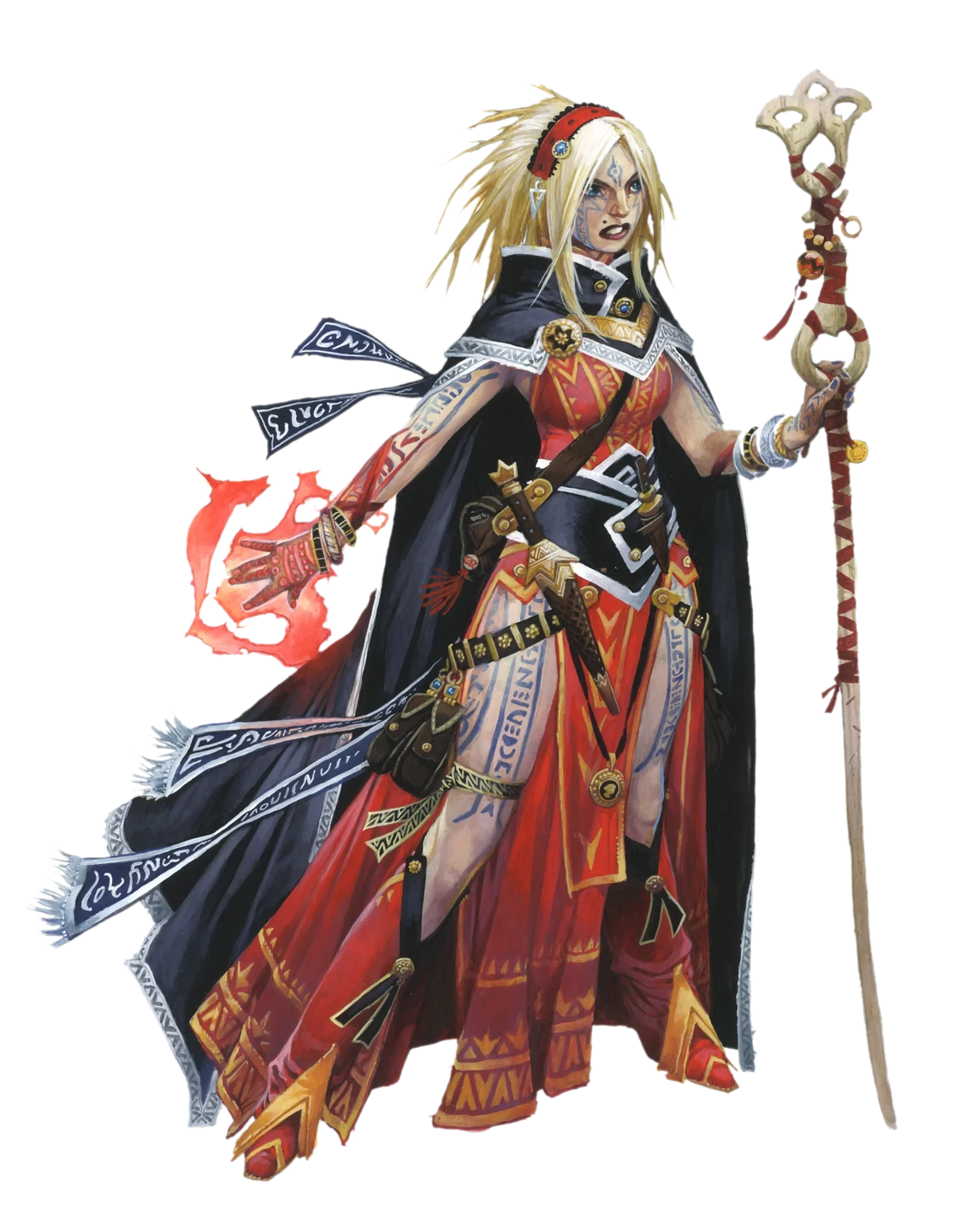
Unlike the barbarians-gone-native on the eastern plateau or the colonial Chelliaxian immigrants of the south, Seoni is a native Varisian, a nomadic race whose closest real-world cultural analogue is the Romani. Or at least, she's mostly Varisian—as might be apparent from her otherworldly grace, there's something not quite human in her ancestry. Though she doesn't have any hard facts, Seoni herself has picked up on some of this, and is constantly pushed to search deeper into the mysteries of her heritage by strange dreams that she doesn't understand.
More than just ornamentation, Seoni's runic tattoos play a large role in her personality. Coming from a people where tattoo magic maintains a strong following, hers are simultaneously a manifestation of her power and a tool to aid in her castings. The sheer number adorning her skin, as well as the similar patterns woven into her clothes, are a mark of status among her tribe, though many of the so-called "civilized" residents of Varisia look upon such body modification with distaste.
Despite being a consummate adventurer, Seoni is something of an enigma to her compatriots. Quietly neutral on most matters, bound by codes and mandates that she rarely feels compelled to explain, the sorceress keeps her emotions tightly bottled. Extremely detail oriented—what the more pugnacious members of her party call a "control freak"—Seoni is a careful and meticulous planner, a schemer who frequently finds herself frustrated by the improvised plans of her more impulsive companions. Despite all of this, Seoni has stuck by her comrades through numerous tight spots, a fact that continues to amaze and confuse Valeros, who wonders loudly (although not altogether unappreciatively) about "the witch and her schemes."
As with so many things, however, if Seoni understands her motivations, she's keeping that knowledge to herself.
⚔ Defense & Saves
- HP: 15/15
- AC: 15
- Perception: +4 (Trained)
- Speed: 25 ft. (land)
- Fortitude: +4 (Trained)
- Reflex: +5 (Trained)
- Will: +6 (Expert)
🗡 Attacks
| Weapon | Traits | Attack Bonus | Damage | |
|---|---|---|---|---|
 |
Staff (Trained) | Monk, Two-Hand-D8 | +3/-2/-7 | 1d4 bludgeoning |
 |
Crossbow (Trained) | — | +5/+0/-5 | 1d8 piercing |
📊 Ability Scores
| STR | DEX | CON | INT | WIS | CHA |
|---|---|---|---|---|---|
| +0 | +2 | +1 | +1 | +1 | +4 |
🎓 Skills
| Skill | Modifier | Proficiency |
|---|---|---|
| Acrobatics | +2 | Untrained |
| Arcana | +4 | Trained |
| Athletics | +0 | Untrained |
| Crafting | +4 | Trained |
| Deception | +7 | Trained |
| Diplomacy | +7 | Trained |
| Hills Lore | +4 | Trained |
| Intimidation | +7 | Trained |
| Medicine | +1 | Untrained |
| Nature | +1 | Untrained |
| Occultism | +1 | Untrained |
| Performance | +4 | Untrained |
| Religion | +1 | Untrained |
| Society | +4 | Trained |
| Stealth | +2 | Untrained |
| Survival | +4 | Trained |
| Thievery | +2 | Untrained |
💰 Wealth & Carry
| Coin | Total Value | Bulk | Invested |
|---|---|---|---|
| 3 SP, 8 CP | 18.01 gp | 3.5 / 5 enc / 10 max | 0/10 |
✨ Feats & Features
Heritage
- Skilled Heritage
- Your ingenuity allows you to train in a wide variety of skills. You become trained in one skill of your choice. At 5th level, you become an expert in the chosen skill.
Background Features
- Nomad
- Traveling far and wide, you picked up basic tactics for surviving on the road and in unknown lands, getting by with few supplies and even fewer comforts. As an adventurer, you travel still, often into even more dangerous places.
- Choose two ability boosts. One must be to Constitution or Wisdom, and one is a free ability boost.
- You're trained in the Survival skill and a Lore skill related to one terrain you traveled in (such as Desert Lore or Swamp Lore). You gain the Assurance skill feat with Survival.
Feats
 Adapted Cantrip (human)
- Through study of multiple magical traditions, you've altered a spell to suit your spellcasting style. Choose one cantrip from a magical tradition other than your own. If you prepare spells, you can choose this spell when you prepare your cantrips, in addition to your other options. If you have a spell repertoire, replace one of your cantrips known with the chosen spell. You can cast this cantrip as a spell of your class's tradition.
- If you swap or retrain this cantrip later, you can choose its replacement from the same alternate tradition or a different one.
- Assurance (Survival) (fortune, general, skill)
- Even in the worst circumstances, you can perform basic tasks. Choose a skill you're trained in. You can forgo rolling a skill check for that skill to instead receive a result of 10 + your proficiency bonus (do not apply any other bonuses, penalties, or modifiers).
- Special You can select this feat multiple times. Each time, choose a different skill and gain the benefits for that skill.
 Bloodline (sorcerer)
- Choose a bloodline that gives you your spellcasting talent. This choice determines the type of spells you cast and the spell list you choose them from, additional spells you learn, and additional trained skills. You also gain Focus Points and special focus spells based on your bloodline. The bloodlines presented are as follows:
- Aberrant A strange and unknowable influence gives you occult spells.
- Angelic Holy grace bestows divine spells upon you.
- Demonic A sinful corruption gives you divine spells.
- Diabolic A bond with devils gives you divine spells.
- Draconic The blood of dragons grants you arcane spells.
- Elemental The power of the elements manifests in you as primal spells.
- Fey Influence from the fey gives you primal spells.
- Genie Through lineage, magic, or wishes made real, the blood of a noble genie flows through your veins.
- Hag The blight of a hag has given you occult spells.
- Harrow You have a deep connection to the harrow.
- Imperial An ancient power grants you arcane spells.
- Nymph One of your ancestors was inspired by a nymph, or perhaps was a nymph themself, and now the beauty of nature lives in you.
- Phoenix The healing fire a phoenix's blessing grants you primal spells.
- Psychopomp For good or ill, your ancestors' deeds drew the attention of psychopomps, or you might somehow count one in your family tree. The presence of these shepherds of souls and enemies of undeath has left an indelible mark on you.
- Shadow Whether due to a velstrac's manipulations or a planar jaunt gone horribly wrong, your bloodline was infused with a vein of shadow.
- Undead The touch of death gives you divine spells.
- Wyrmblessed A draconic blessing grants you divine spells.
 Bloodline Spells (sorcerer)
- Your bloodline grants you bloodline spells, special spells unique to your lineage. Bloodline spells are a type of focus spell. It costs 1 Focus Point to cast a focus spell, and you start with a focus pool of 1 Focus Point. You refill your focus pool during your daily preparations, and you can regain 1 Focus Point by spending 10 minutes using the Refocus activity. Unlike other characters, you don't need to do anything specific to Refocus, as the power flowing through your veins naturally replenishes your focus pool.
- Focus spells are automatically heightened to half your level rounded up, much like cantrips. Focus spells don't require spell slots; you can't cast them using spell slots. The maximum Focus Points your focus pool can hold is equal to the number of focus spells you have, but can never be more than 3 points. The full rules are on page 298 of Player Core. You learn the initial bloodline spell, which is unique to your bloodline.
- ==== Reading a Bloodline Entry ====
- A bloodline entry contains the following information.
- Tradition You use this magical tradition and spell list
- Bloodline Skills You become trained in the listed skills.
- Sorcerous Gifts You automatically add the spells listed here to your spell repertoire, as described in the Spell Repertoire feature. At 1st level, you gain a cantrip and a 1st-rank spell. You learn the other spells on the list as soon as you gain the ability to cast sorcerer spells of that rank.
- Bloodline Spells You automatically gain the initial bloodline spell at 1st level and can gain more by selecting the Advanced Bloodline and Greater Bloodline feats.
- Blood Magic Whenever you cast a bloodline spell using a Focus Point or a sorcerous gift spell using a spell slot, you choose one blood magic effect you know to benefit from. You begin play with the benefit listed in your bloodline and can gain others through sorcerer feats.
- If the blood magic effect offers a choice, make it before resolving the spell. The blood magic effect occurs after resolving any checks for the spell's initial effects and, against a foe, applies only if the spell is a successful attack or the foe fails its saving throw. If the spell has an area, you must designate yourself or one target in the area when you cast the spell to be the target of the blood magic effect. All references to spell rank refer to the rank of the spell you cast.
 Bloodline: Imperial (sorcerer)
- One of your ancestors was a mortal who mastered magic.
- Tradition arcane
- Bloodline Skills Arcana, Society
- Sorcerous Gifts cantrip Detect Magic, 1st: Force Barrage, 2nd: Dispel Magic, 3rd: Haste, 4th: Translocate, 5th: Scouting Eye, 6th: Disintegrate, 7th: Retrocognition, 8th: Quandary, 9th: Implosion
- Bloodline Spells initial: Ancestral Memories, advanced: Extend Blood Magic, greater: Arcane Countermeasure
- Blood Magic—Imperious Defense Raw magic emanates from every cell in your body, protecting you. Until the start of your next turn, you gain your choice of either a +1 status bonus to AC or a +1 status bonus to saving throws.
- Effect: Imperial Blood Magic
 Sorcerer Spellcasting (sorcerer)
- === Sorcerer Spellcasting ===
- Your bloodline provides you with incredible magical power. You are a spellcaster and can cast spells using the Cast a Spell activity. The tradition from which your spells come is determined by your bloodline. As a sorcerer, you draw your power from within, and the gestures and incantations you use to shape your power might evoke the nature of your bloodline. For instance, a sorcerer with a demonic bloodline might chant guttural fiendish phrases or make brief curt gestures to cast a spell.
- Each day, you can cast up to three 1st-rank spells. You must know spells to cast them, and you learn them via the spell repertoire class feature. The number of spells you can cast each day is called your spell slots.
- As you increase in level as a sorcerer, your number of spells per day increases, as does the highest rank of spells you can cast, as shown on the Sorcerer Spells per Day table.
- Some of your spells require you to attempt a spell attack to see how effective they are, or have your enemies roll against your spell DC (typically by attempting a saving throw). Since your key attribute is Charisma, your spell attack modifier and spell DC use your Charisma modifier.
- ==== Heightening Spells ====
- When you get spell slots of 2nd rank and higher, you can fill those slots with stronger versions of lower-rank spells. This increases the spell's rank, heightening it to match the spell slot. You must have a spell in your spell repertoire at the rank you want to cast it in order to heighten it to that rank. Many spells have specific improvements when they are heightened to certain ranks. The signature spells class feature lets you heighten certain spells freely.
- ==== Cantrips ====
- Some of your spells are cantrips. A cantrip is a special type of spell that doesn't use spell slots. You can cast a cantrip at will, any number of times per day. A cantrip is always automatically heightened to half your level rounded up—this is usually equal to the highest rank of sorcerer spell slot you have. For example, as a 1st-level sorcerer, your cantrips are 1st-rank spells, and as a 5th-level sorcerer, your cantrips are 3rd-rank spells.
- Your Level Cantrips 1st 2nd 3rd 4th 5th 6th 7th 8th 9th 10th
- 1 5 3 - - - - - - - - -
- 2 5 4 - - - - - - - - -
- 3 5 4 3 - - - - - - - -
- 4 5 4 4 - - - - - - - -
- 5 5 4 4 3 - - - - - - -
- 6 5 4 4 4 - - - - - - -
- 7 5 4 4 4 3 - - - - - -
- 8 5 4 4 4 4 - - - - - -
- 9 5 4 4 4 4 3 - - - - -
- 10 5 4 4 4 4 4 - - - - -
- 11 5 4 4 4 4 4 3 - - - -
- 12 5 4 4 4 4 4 4 - - - -
- 13 5 4 4 4 4 4 4 3 - - -
- 14 5 4 4 4 4 4 4 4 - - -
- 15 5 4 4 4 4 4 4 4 3 - -
- 16 5 4 4 4 4 4 4 4 4 - -
- 17 5 4 4 4 4 4 4 4 4 3 -
- 18 5 4 4 4 4 4 4 4 4 4 -
- 19 5 4 4 4 4 4 4 4 4 4 1*
- 20 5 4 4 4 4 4 4 4 4 4 1*
- The bloodline paragon class feature gives you a 10th-rank spell slot that works a bit differently from other spell slots.
 Sorcerous Potency (sorcerer)
- Because of the magical power inherent in your blood, your spells that hurt or cure are stronger than those of other spellcasters. When you Cast a Spell from your spell slots that either deals damage or restores Hit Points, you gain a status bonus to that spell's damage or healing equal to the spell's rank. This applies only to the initial damage or healing the spell deals when cast. An individual creature takes this damage or benefits from this healing only once per spell, even if the spell would damage or heal that creature multiple times.
 Spell Repertoire (bard, oracle, psychic, sorcerer, summoner)
- Bard The collection of spells you can cast is called your spell repertoire. At 1st level, you learn two 1st-rank occult spells of your choice and five occult cantrips of your choice. You choose these from the common spells from the occult list or from other occult spells to which you have access. You can cast any spell in your spell repertoire by using a spell slot of an appropriate spell rank.
- You add to this spell repertoire as you increase in level. Each time you get a spell slot (see the Bard Spells per Day table), you add a spell to your spell repertoire of the same rank. At 2nd level, you select another 1st-rank spell; at 3rd level, you select two 2nd-rank spells, and so on. When you add spells, you might add a higher-rank version of a spell you already have, so you can cast a heightened version of that spell.
- Though you gain them at the same rate, your spell slots and the spells in your spell repertoire are separate. If a feat or other ability adds a spell to your spell repertoire, it wouldn't give you another spell slot, and vice versa.
- Swapping Spells in Your Repertoire
- As you gain new spells in your repertoire, you might want to replace some of the spells you previously learned. Each time you gain a level and learn new spells, you can swap out one of your old spells for a different spell of the same rank. This spell can be a cantrip. You can also swap out spells by retraining during downtime.
- Oracle The collection of spells you can cast is called your spell repertoire. At 1st level, you learn two 1st-rank divine spells of your choice and five divine cantrips of your choice. You choose these from the common spells on the divine list or from other divine spells to which you have access. You can cast any spell in your spell repertoire by using a spell slot of an appropriate spell rank.
- You add to this spell repertoire as you increase in level. Each time you get a spell slot (see the Oracle Spells per Day table), you add a spell to your spell repertoire of the same rank. At 2nd level, you select another 1st-rank spell; at 3rd level, you select two 2nd-rank spells, and so on. When you add spells, you might add a higher-rank version of a spell you already have, so you can cast a heightened version of that spell.
- Your spell slots and the spells in your spell repertoire are separate. If a feat or other ability adds a spell to your spell repertoire, it wouldn't give you another spell slot, and vice versa.
- Swapping Spells in Your Repertoire
- As you gain new spells in your repertoire, you might want to replace some of the spells you previously learned. Each time you gain a level and learn new spells, you can swap out one of your old spells for a different spell of the same rank. This spell can be a cantrip. You can also swap out spells by retraining during downtime.
- Psychic The collection of spells you can cast is called your spell repertoire. At 1st level, you learn one 1st-rank occult spell of your choice and three occult cantrips of your choice. You choose these from the common spells from the occult list or from other occult spells to which you have access. You can cast any spell in your spell repertoire by using a spell slot of an appropriate spell rank. Your choice of conscious mind also grants you additional spells in your repertoire, starting with an additional 1st-rabk spell and two cantrips listed in your conscious mind, which you cast as psi cantrips.
- You add to this spell repertoire as you increase in level. Each time you get a spell slot (see Table 2), you add a spell to your spell repertoire of the same level. At 2nd level, you select another 1st-rank spell; at 3rd level, you select one 2nd-level spell, and so on. When you add spells, you might add a higher-rank version of a spell you already have, so you can cast a heightened version of that spell. Your conscious mind also adds additional spells to your repertoire as you gain spells of higher levels.
- Though you gain them at the same rate, your spell slots and the spells in your spell repertoire are separate. If a feat or other ability adds a spell to your spell repertoire, such as the spells you gain from your conscious mind, it wouldn't give you another spell slot, and vice versa.
- Swapping Spells in Your Repertoire
- As you gain new spells in your repertoire, you might want to replace some of the spells you previously learned. Each time you gain a level and learn new spells, you can swap out one of your old spells for a different spell of the same rank. This spell can be a cantrip. You can also swap out spells by retraining during downtime.
- Sorcerer The collection of spells you can cast is called your spell repertoire. At 1st level, you learn two 1st-rank spells of your choice and four cantrips of your choice, as well as an additional spell and cantrip from your bloodline. You choose these from the common spells from the tradition corresponding to your bloodline, or from other spells from that tradition to which you have access. You can cast any spell in your spell repertoire by using a spell slot of an appropriate spell rank.
- You add to this spell repertoire as you increase in level. Each time you get a spell slot (see the Sorcerer Spells per Day table above), you add a spell to your spell repertoire of the same rank. When you gain a new rank of spells, your first new spell is always the sorcerous gift spell for that rank that's listed in your bloodline, but you can choose the other spells. At 2nd level, you select another 1st-rank spell; at 3rd level, you gain a new spell from your bloodline and two other 2nd-rank spells, and so on. When you add spells, you might select a higher-rank version of a spell you already know so that you can cast a heightened version of that spell.
- Though you gain them at the same rate, your spell slots and the spells in your spell repertoire are separate. If a feat or other ability adds a spell to your spell repertoire, it wouldn't give you another spell slot or vice versa.
- Swapping Spells in Your Repertoire
- As you gain new spells in your spell repertoire, you might want to replace some of the spells you previously learned. Each time you gain a level and learn new spells, you can swap out one of your old spells for a different spell of the same rank. This spell can be a cantrip, but you can't swap out bloodline spells. You can also swap out spells by retraining during downtime.
- Summoner The collection of spells you can cast is called your spell repertoire. At 1st level, you learn two 1st-rank spells of your choice and five cantrips of your choice. You choose these from the common spells from the tradition corresponding to your eidolon, or from other spells from that tradition to which you have access. You can cast any spell in your spell repertoire by using a spell slot of an appropriate spell rank. Your spell slots and the spells in your spell repertoire are separate. If a feat or other ability adds a spell to your spell repertoire, it doesn't give you another spell slot, and vice versa.
- You add to this spell repertoire as you increase in level. Each time you get a spell slot (see Table 2–4: Summoner Spells per Day), you add a spell of the same rank to your spell repertoire. At 2nd level, you select another 1st-rank spell. At 3rd level, you add the first 2nd-rank spell to your repertoire. At 4th level you gain your second and your spell repertoire reaches its maximum size of five spells.
- At 5th level, in addition to adding two 3rd-rank spells to your repertoire, you lose your lowest rank of spell slots. Any time you lose a rank of spell slots, you lose two spells in your repertoire as well. These can come from spells you already know or out of the number of new spells you're learning. On levels in which you don't change your spell slots, you can swap out multiple spells, as described below.
- Swapping Spells in Your Repertoire
- As you gain new spells in your repertoire, you might want to replace some of the spells you previously learned. Each time you gain a level and learn new spells, you can swap out one of your old spells for a different spell of the same rank. If it's a rank at which you lose a set of lower-rank slots, you can replace the two in either order. You can also instead swap a cantrip. You can also swap out spells by retraining during downtime.
- At 6th level and every even level thereafter, you can swap out any number of your spells for different spells of a rank you can cast. When you do, you must keep at least one spell you can cast with your lowest rank of spell slots so you don't end up with slots you can't use. For instance, at 6th level you would need to keep at least one 2nd-rank spell, but all your other spells could be 3rd rank.
🎒 Inventory
Weapons
| Item | Qty | Bulk | Level | Price | |
|---|---|---|---|---|---|
|
Crossbow | 1 | 1 | 0 | 3 gp |
|
Staff | 1 | 1 | 0 | — |
Armor & Shields
| Item | Qty | Bulk | Level | Price | |
|---|---|---|---|---|---|
 |
Explorer's Clothing | 1 | 0.1 | 0 | 1 sp |
Consumables
| Item | Qty | Bulk | Level | Price | |
|---|---|---|---|---|---|
 |
Antidote (Lesser) | 1 | 0.1 | 1 | 3 gp |
 |
Elixir of Life (Minor) | 3 | 0.1 | 1 | 3 gp |
Ammunition
| Item | Qty | Bulk | Level | Price | |
|---|---|---|---|---|---|
 |
Bolts | 10 | 0.1 | 0 | 1 sp |
Bags & Storage
| Item | Qty | Bulk | Level | Price | |
|---|---|---|---|---|---|
 |
Backpack | 1 | 0 | 0 | 1 sp |
| |||||





Treasure & Currency
| Item | Qty | Bulk | Level | Price | |
|---|---|---|---|---|---|
 |
Copper Pieces | 8 | 1 | 0 | 1 cp |
 |
Silver Pieces | 3 | 1 | 0 | 1 sp |
🔮 Spellcasting
Arcane Focus Spells (Arcane) — Focus
- DC 17 | Attack +7
Rank 1
 Ancestral Memories [concentrate, focus, sorcerer]
Description
The memories of long-dead spellcasters grant you knowledge in a specific skill. Choose any non-Lore skill, or a Lore skill related to the ancient empire from which your bloodline sprang. You temporarily become trained in that skill and might gain other memories associated with an ancestor who was trained in that skill. If you attempt a task or activity that lasts beyond this spell's duration, use the lower proficiency modifier.
Heightened (6th) You temporarily become an expert in the skill you choose.
Arcane Spontaneous Spells (Arcane) — Spontaneous
- DC 17 | Attack +7
Rank 1 (3/3 slots)
 Caustic Blast [acid, cantrip, concentrate, manipulate]
Description
You fling a large glob of acid that immediately detonates, spraying nearby creatures. Creatures in the area take 1d8 acid damage with a basic Reflex save; on a critical failure, the creature also takes 1+floor((@item.rank -1)/2) persistent acid damage damage.
Heightened (+2) The initial damage increases by 1d8, and the persistent damage on a critical failure increases by 1.
 Detect Magic [cantrip, concentrate, detection, manipulate]
Description
You send out a pulse that registers the presence of magic. You receive no information beyond the presence or absence of magic. You can choose to ignore magic you're fully aware of, such as the magic items and ongoing spells of you and your allies. You detect illusion magic only if that magic's effect has a lower rank than the rank of your detect magic spell. However, items that have an illusion aura but aren't deceptive in appearance (such as an Invisibility Potion) typically are detected normally.
Heightened (3rd) You learn the rank or level of the most powerful magical effect the spell detects, as determined by the GM.
Heightened (4th) As 3rd rank, but you also pinpoint the source of the highest-rank magic. Like for an imprecise sense, you don't learn the exact location, but can narrow down the source to within a 5-foot cube (or the nearest if larger than that).
 Dizzying Colors [concentrate, illusion, incapacitation, manipulate, visual]
Description
You unleash a swirling multitude of colors that overwhelms creatures based on their Will saves.
Critical Success The creature is unaffected.
Success The creature is Dazzled for 1 round.
Failure The creature is Stunned 1, Blinded for 1 round, and dazzled for 1 minute.
Critical Failure The creature is stunned for 1 round and blinded for 1 minute.
 Forbidding Ward [cantrip, concentrate, manipulate]
Description
You ward an ally against the attacks and hostile spells from the target enemy. The target ally gains a +1 status bonus to Armor Class and saving throws against the target enemy's attacks, spells, and other effects.
Spell Effect: Forbidding Ward
Heightened (6th) The status bonus increases to +2.
 Force Barrage [concentrate, force, manipulate]
Description
You fire a shard of solidified magic toward a creature that you can see. It automatically hits and deals 1d4+1 force damage. For each additional action you use when Casting the Spell, increase the number of shards you shoot by one, to a maximum of three shards for 3 actions. You choose the target for each shard individually. If you shoot more than one shard at the same target, combine the damage before applying bonuses or penalties to damage, resistances, weaknesses, and so forth.
Heightened (+2) You fire one additional shard with each action you spend.
 Frostbite [cantrip, cold, concentrate, manipulate]
Description
An orb of biting cold coalesces around your target, freezing its body. The target takes 2d4 cold damage with a basic Fortitude save. On a critical failure, the target also gains weakness 1 to bludgeoning until the start of your next turn.
Spell Effect: Frostbite
Heightened (+1) The damage increases by 1d4 and the weakness on a critical failure increases by 1.
 Grim Tendrils [concentrate, manipulate, void]
Description
Tendrils of darkness curl out from your fingertips and race through the air. You deal 2d4 void damage and @item.level bleed damage damage to living creatures in the line. Each living creature in the line must attempt a Fortitude save.
Critical Success The creature is unaffected.
Success The creature takes half the void damage and no persistent bleed damage.
Failure The creature takes full damage.
Critical Failure The creature takes double void damage and double persistent bleed damage.
Heightened (+1) The void damage increases by 2d4, and the persistent bleed damage increases by 1.
 Shield [cantrip, concentrate, force]
Description
You raise a magical shield of force. This counts as using the Raise a Shield action, giving you a +1 circumstance bonus to AC until the start of your next turn, but it doesn't require a hand to use.
While the spell is in effect, you can use the Shield Block reaction with your magic shield. The shield has Hardness 5. You can use the spell's reaction to reduce damage from any spell or magical effect, even if it doesn't deal physical damage. After you use Shield Block, the spell ends and you can't cast it again for 10 minutes.
Spell Effect: Shield
Effect: Shield Immunity
Heightened (+2) The shield's Hardness increases by 5.
Last synced: 2026-08-24 04:00